hurozo Attend
First step

Set up your first agency

Create an agency, add workers, attach canon, and assign its first task.

Worker Tools

Manage worker

Tune the role and tools for this agency teammate. Graph wiring stays internal.

Tools

Loading...

Worker View

No tools selected
Team worker Untitled Agent Describe what this agent should do. HurozoAgent

Worker Chat

Describe the worker you want to add to this team, or what you want to change.
Draft JSON
{}

Teams

Teams are managed from Agency.

Connectors

Connectors

Connect services for the current agency

Loading connectors…

Agency

Team workspace

Planning

Filters

Build

Runs

Execution activity

Runs

Inspect Worker work, tool calls, reasoning summaries, and failures.

Select a run to inspect its activity.

Files

Agency files

    Documentation

    Contact Us

    New message

    To: hi@hurozo.com

    Hurozo CLI

    Terminal-first agent work

    Hurozo CLI

    The same Hurozo agent runtime, model routes, approvals, and connected tools from your shell.

    Install with Homebrew
    brew tap hurozo/hurozo-cli
    brew install hurozo-cli
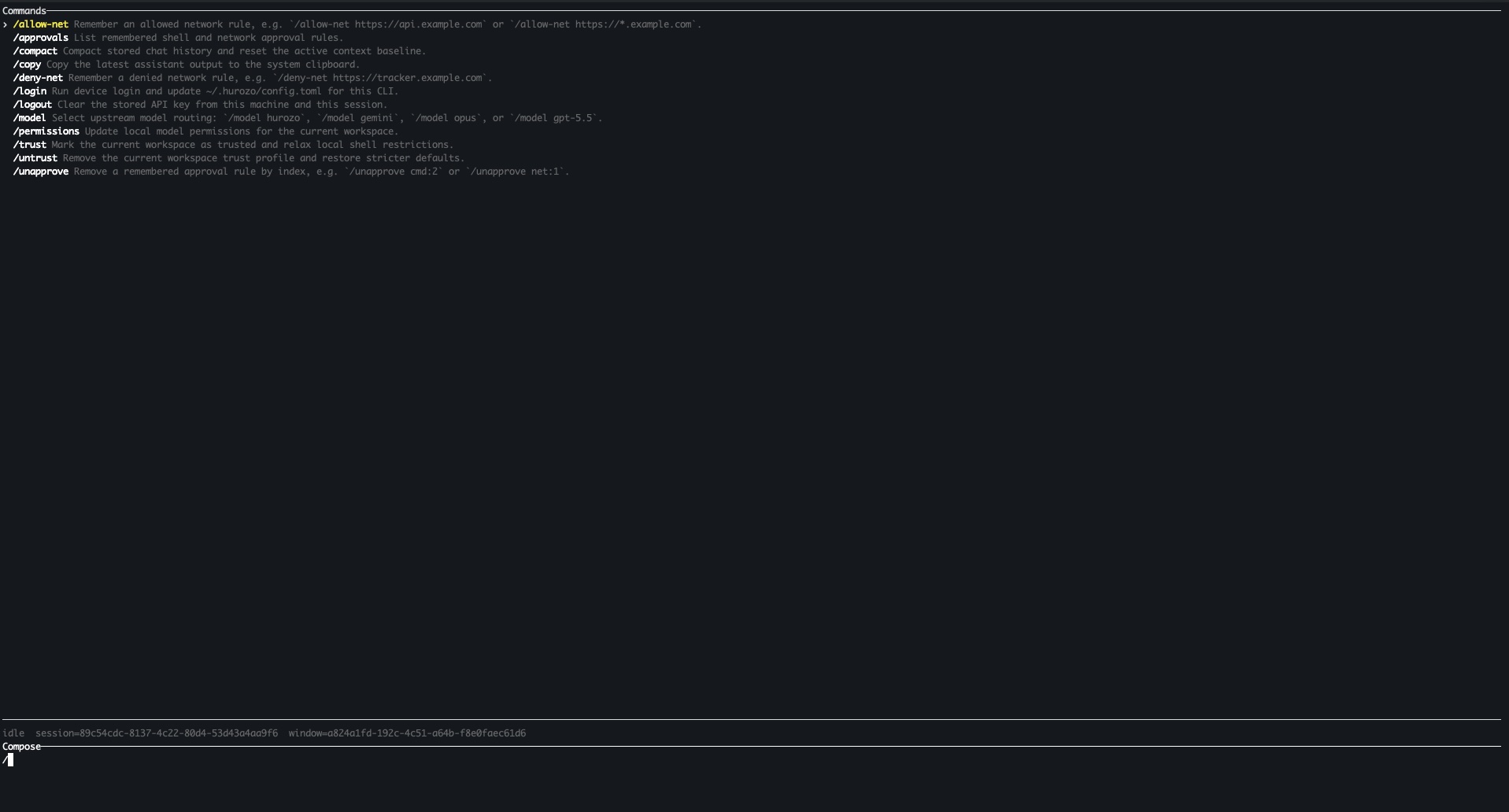
    Hurozo CLI running in a terminal

    Model routing

    Switch between Hurozo, Gemini, Opus, and ChatGPT-backed routes when your account is configured for them.

    Approvals

    Review tool permissions from the terminal and keep remembered decisions scoped to the exact operation.

    Second opinions

    Use model arbitration to ask another available route for critique, checks, or a different perspective.

    Connected tools

    Use the same account-backed connectors and skills available in Hurozo's desktop and WebCLI experiences.

    First run

    After installation, run hurozo. The CLI walks you through account authentication and any model-specific sign-in or secret setup that your selected route requires.

    Hurozo SDK

    Python agent invocation

    Hurozo SDK

    Invoke saved Hurozo agents from Python using the same API tokens, inputs, outputs, and runtime routing used by Agent Builder.

    Install
    pip install hurozo
    getting_started.pyPython
    import json
    import os
    
    from hurozo import Agent
    
    os.environ["HUROZO_API_TOKEN"] = "YOUR_API_TOKEN"
    agent = Agent("sentiment-analyser")
    inputs = {
        "prompt": "Analyze sentiment and return JSON. Text:",
        "input": "I am very happy!",
    }
    
    result = agent.run(inputs)
    print(json.dumps(result, indent=2))

    Agent lookup

    Use an agent name, saved agent id, or agent UUID. The SDK resolves the correct execution target.

    Structured inputs

    Pass a Python dictionary matching the API input keys exposed by the saved workflow.

    Hosted runtime

    Runs against Hurozo's execution endpoint, including model routing, tools, outputs, and usage accounting.

    Token setup

    Create an API token from Account settings -> Manage API Tokens, then set it as HUROZO_API_TOKEN before running scripts.

    Trust, security, and control

    You reached security review. Here is the honest page.

    This is the page you send to IT, risk, and legal. It splits what Attend proves today from what we are still building, in plain words, so nothing here surprises anyone in week six.

    Your model, your keys EU AI Act, by design Every run leaves a trace

    Two labels run through this page. Today means it works now and you can see it. Roadmap means it is planned or built on validated demand, not a promise you can act on yet. We do not dress a roadmap item as a fact.

    You have seen how this goes

    the review that stalls
    The region answer changed depending on who you asked.
    Sales said EU. The doc said something else. Nobody could point to the setting.
    The approval only existed in the demo.
    "A human checks it" turned out to mean one screen in the pitch, not a real gate you control.
    The audit log could not reconstruct the send.
    When you asked to see exactly what went out and why, the trail had holes.
    The promised document was a dead link.
    The security overview, the DPA, the pen-test summary. Requested, then silence.

    If you have run a vendor through review, you know these. So here is Attend split straight down the middle: what we prove today, and where we tell you plainly the work is not done.

    What Attend proves today

    marked Today, you can see it
    Received
    Refund, damaged on arrival
    09:38:05
    Drafted
    From your canon, account facts pulled
    09:38:12
    Held for a person
    A person decides. Nothing sent
    09:38:12
    Approved
    by you
    09:41:20
    Sent, and recorded
    the run trace kept, step by step
    09:41:21
    run-trace-4471steps, tools, and approvals
    Inspect the run
    Run events recorded when they occurPermissions set per workerEncrypted at rest, records keyed by Agency

    This is a sample of the run trace Attend keeps for every Worker run. You can inspect it in the product, step by step. Full one-click regulator-grade export is on the roadmap, marked below. See the ticket log

    What is true today

    substantiated, present tense

    Your model, your keys

    Route to Anthropic, Google, or OpenAI on your own provider keys, configured for the selected Agency. Swap models without rebuilding a workflow.

    Today

    The gate, per capability

    Every capability a worker has is set to allow, hold for a person, or off. The calls you mark for a person wait for a person before anything happens.

    Today

    Every run leaves a trace

    Run logs retain the emitted progress, tool-call, approval, outcome, and error events when they occur, kept and inspectable in the product. You can see what a worker did and when.

    Today

    Encrypted, scoped access

    Traffic uses TLS, and managed GCP storage provides encryption at rest. Application records are keyed and authorized by user and Agency.

    Today

    Your data, not our training set

    Your conversations and canon are not used to train shared Hurozo models. When you bring your own model, data use follows that provider's contract, which we help you check.

    Today

    EU AI Act, by design

    The product is designed around the record-keeping, transparency, and human-oversight concepts associated with Articles 12 to 14. This is design intent, not a compliance assessment or certification.

    Today

    On the roadmap

    planned or on validated demand, not yet

    EU-resident deployment

    Today Hurozo's managed control plane and primary application state run in US GCP regions. Some user object storage is EU-located, and model or provider processing follows the selected route. EU-resident managed and self-hosted options are what we are building toward. We will not claim "in region" until it is true.

    Roadmap

    SSO and SCIM

    SAML and OIDC single sign-on and SCIM provisioning, so access follows your directory and leavers lose it automatically. Planned, not available yet.

    Roadmap

    Status page and failover

    A public status page and provider failover are planned. Today the runtime does not silently fail over. It surfaces the error rather than hide it.

    Roadmap

    Live operations console

    Latency, cost, and error rates per crew and per model, live in the console with export to your own tools. On the roadmap.

    Roadmap

    Regulator-grade export

    Full one-click per-ticket export and replay, packaged for a regulator. Today the run trace is inspectable in the product. The packaged export is on the roadmap.

    Roadmap

    Self-host and your VPC

    Running the full product in your own VPC is a target we are validating, not a supported path today. A remote worker can run on your side now; the control plane and stored data stay managed for the moment.

    Roadmap

    Compliance and documents

    current status, in writing
    EU AI ActDesigned around the record-keeping, transparency, and human-oversight concepts in Articles 12 to 14. Design intent, not a compliance assessment or certification.by design
    SOC 2 and ISO 27001Not certified. The current status is confirmed by the Hurozo team in writing.ask us
    GDPR and DPAContact us for the current data processing agreement status.ask us
    SubprocessorsContact us for the current subprocessor-list status.ask us
    Penetration testContact us for the current penetration-test status.ask us

    We do not post a status we cannot stand behind. Ask us, and you get the current state in writing, including what is not done yet.

    Send us to your security team.

    One page that separates what we prove today from what we are building. No surprises in week six.

    See it work