hurozo Attend
First step

Set up your first agency

Create an agency, add workers, attach canon, and assign its first task.

Worker Tools

Manage worker

Tune the role and tools for this agency teammate. Graph wiring stays internal.

Tools

Loading...

Worker View

No tools selected
Team worker Untitled Agent Describe what this agent should do. HurozoAgent

Worker Chat

Describe the worker you want to add to this team, or what you want to change.
Draft JSON
{}

Teams

Teams are managed from Agency.

Connectors

Connectors

Connect services for the current agency

Loading connectors…

Agency

Team workspace

Planning

Filters

Build

Runs

Execution activity

Runs

Inspect Worker work, tool calls, reasoning summaries, and failures.

Select a run to inspect its activity.

Files

Agency files

    Documentation

    Contact Us

    New message

    To: hi@hurozo.com

    Hurozo CLI

    Terminal-first agent work

    Hurozo CLI

    The same Hurozo agent runtime, model routes, approvals, and connected tools from your shell.

    Install with Homebrew
    brew tap hurozo/hurozo-cli
    brew install hurozo-cli
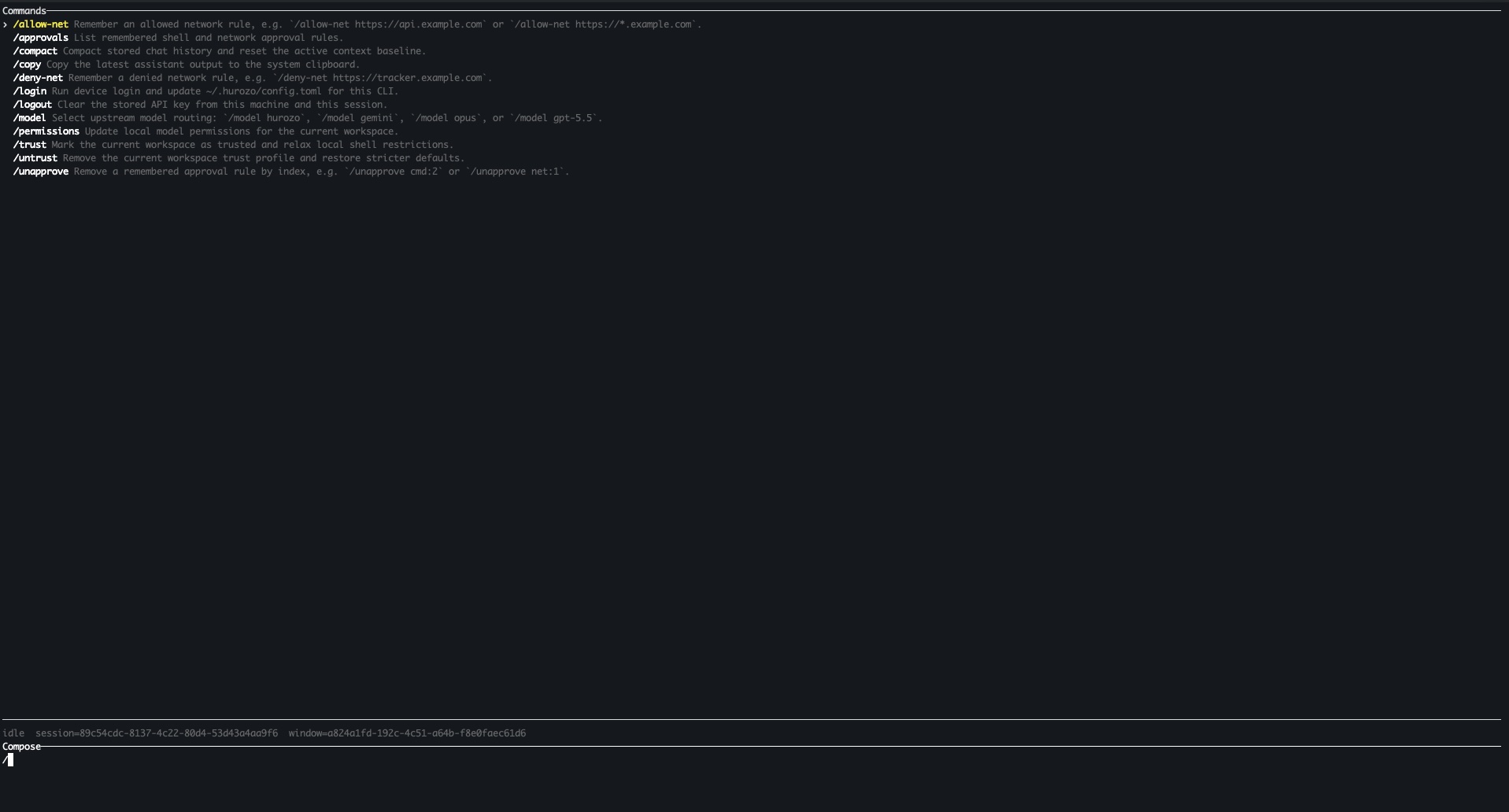
    Hurozo CLI running in a terminal

    Model routing

    Switch between Hurozo, Gemini, Opus, and ChatGPT-backed routes when your account is configured for them.

    Approvals

    Review tool permissions from the terminal and keep remembered decisions scoped to the exact operation.

    Second opinions

    Use model arbitration to ask another available route for critique, checks, or a different perspective.

    Connected tools

    Use the same account-backed connectors and skills available in Hurozo's desktop and WebCLI experiences.

    First run

    After installation, run hurozo. The CLI walks you through account authentication and any model-specific sign-in or secret setup that your selected route requires.

    Hurozo SDK

    Python agent invocation

    Hurozo SDK

    Invoke saved Hurozo agents from Python using the same API tokens, inputs, outputs, and runtime routing used by Agent Builder.

    Install
    pip install hurozo
    getting_started.pyPython
    import json
    import os
    
    from hurozo import Agent
    
    os.environ["HUROZO_API_TOKEN"] = "YOUR_API_TOKEN"
    agent = Agent("sentiment-analyser")
    inputs = {
        "prompt": "Analyze sentiment and return JSON. Text:",
        "input": "I am very happy!",
    }
    
    result = agent.run(inputs)
    print(json.dumps(result, indent=2))

    Agent lookup

    Use an agent name, saved agent id, or agent UUID. The SDK resolves the correct execution target.

    Structured inputs

    Pass a Python dictionary matching the API input keys exposed by the saved workflow.

    Hosted runtime

    Runs against Hurozo's execution endpoint, including model routing, tools, outputs, and usage accounting.

    Token setup

    Create an API token from Account settings -> Manage API Tokens, then set it as HUROZO_API_TOKEN before running scripts.

    Why we exist

    The wall moved. So did we.

    For a decade the wall in AI was capability, whether a model could do the useful work at all. That wall has fallen. A model can draft a reply, pull the account, check a policy.

    The wall that is left is a different one, and it is the one every accountable person now stands at. Can you let AI act on your customers, and prove a human stayed in control while it did. We build for the person caught there.

    Why now, and why support

    the origin

    Two things made that wall urgent in the same year. The public failures went viral, a company swaps its support for a hand-built bot, a paying customer cannot reach a human, and it lands on the front page. And the EU AI Act put "prove it" on the clock, moving it from good practice toward a legal expectation with timelines.

    We did not start at support. We started at the operator, the person who has to run AI they are accountable for without living in the code. Demand discovery corrected our first framing. The pull was sharper and the same across industries. A person has to sign off on AI-touched work, later prove they did, and right now the proof is scattered across chats, spreadsheets, and tools they do not own.

    Support turned out to be that pattern, felt daily and demoable in seconds. Every ticket is a live test of what your actual policy is, answered by a person who is on the hook for the reply. It is high stakes, it is un-owned, and the failure is public in a way a compliance workflow never is. So support became the first hire, the sharpest door into the thesis, not a pivot away from it.

    Why this team

    two lines of work that had to meet
    Thorsten

    The operating discipline. Through Product.Zone he spent years turning a company's scattered operating knowledge, its policies, its exceptions, the decisions that lived in one person's head, into a governed system of record. The insight that this knowledge should become an owned, provable asset rather than evaporate is the seed of Attend's canon.

    Thorsten on LinkedIn
    Dennis

    The architecture. He built the runtime where governance and canonical knowledge are first-class objects, not features bolted on, and where the surface you try and the product you buy are one. That is why Attend can prove every action by construction. A worker cannot act without writing the record.

    Dennis on LinkedIn

    Neither half is enough alone. An operating method without a runtime is a slide deck. A runtime without an operating method is another agent framework. Attend is the two together, aimed at one accountable job.

    What we are building

    the support crew you own

    Attend, a support workforce you staff, govern, and own.

    Every worker proves itself in seconds, holds the actions you gate, is built so a customer can always reach a human, and builds your company's canon as it goes. Your model, yours to keep, with EU residency on our roadmap. We start with support because it is where a company's real rules get tested every day. The destination is unchanged. Your customer operations become a system you own, and your institutional knowledge compounds instead of walking out the door.

    See what owning it looks like.

    Twenty minutes, on your own inbox, no rug-pull. What you try is what you keep.

    Book a demo