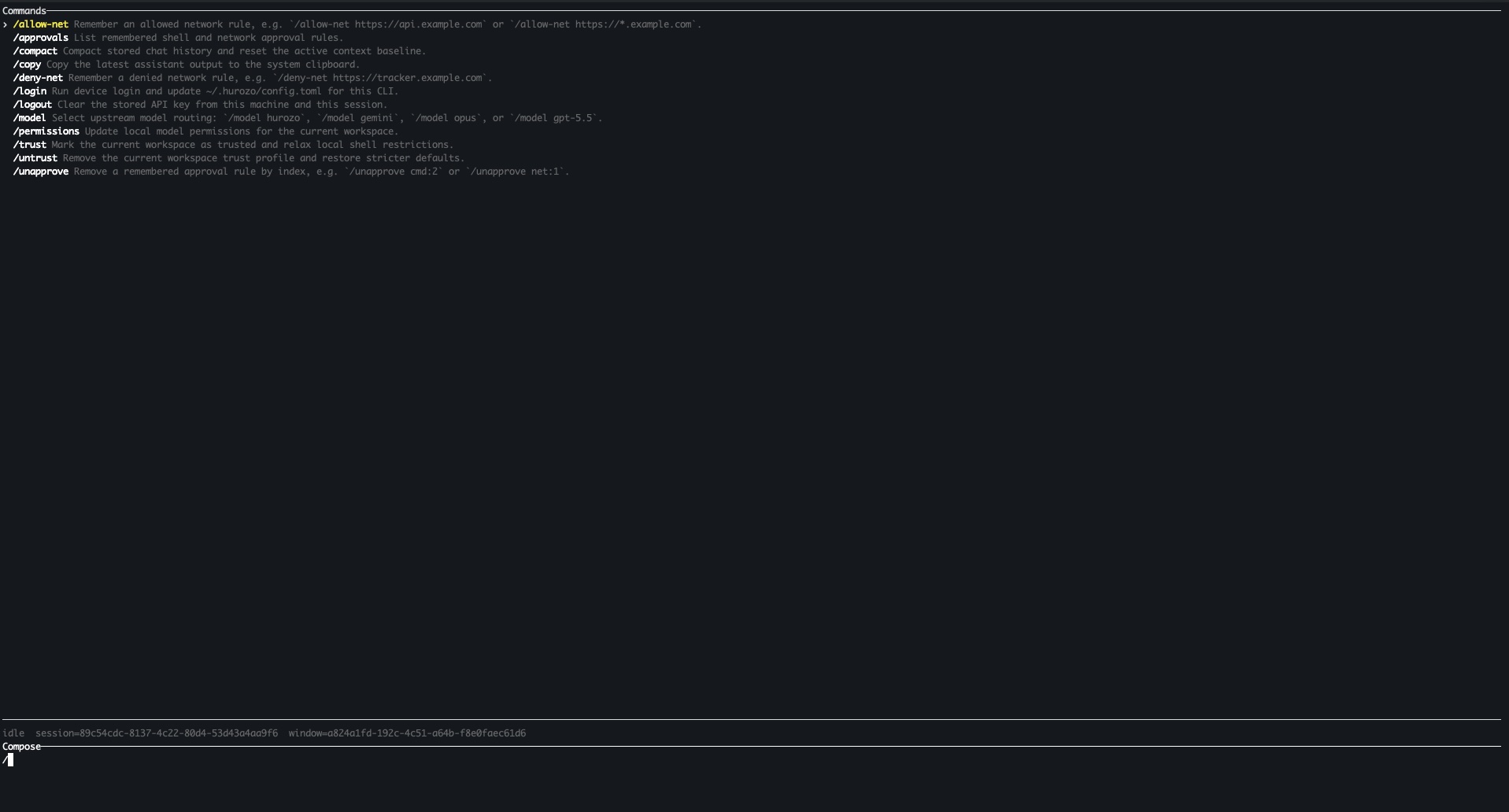
Switch between Hurozo, Gemini, Opus, and ChatGPT-backed routes when your account is configured for them.
Approvals
Review tool permissions from the terminal and keep remembered decisions scoped to the exact operation.
Second opinions
Use model arbitration to ask another available route for critique, checks, or a different perspective.
Connected tools
Use the same account-backed connectors and skills available in Hurozo's desktop and WebCLI experiences.
First run
After installation, run hurozo. The CLI walks you through account authentication and any model-specific sign-in or secret setup that your selected route requires.
Hurozo SDK
Python agent invocation
Hurozo SDK
Invoke saved Hurozo agents from Python using the same API tokens, inputs, outputs, and runtime routing used by Agent Builder.
Install
pip install hurozo
getting_started.pyPython
import json
import os

from hurozo import Agent

os.environ["HUROZO_API_TOKEN"] = "YOUR_API_TOKEN"
agent = Agent("sentiment-analyser")
inputs = {
    "prompt": "Analyze sentiment and return JSON. Text:",
    "input": "I am very happy!",
}

result = agent.run(inputs)
print(json.dumps(result, indent=2))
Agent lookup
Use an agent name, saved agent id, or agent UUID. The SDK resolves the correct execution target.
Structured inputs
Pass a Python dictionary matching the API input keys exposed by the saved workflow.
Hosted runtime
Runs against Hurozo's execution endpoint, including model routing, tools, outputs, and usage accounting.
Token setup
Create an API token from Account settings -> Manage API Tokens, then set it as HUROZO_API_TOKEN before running scripts.
Continue to Hurozo
Use a social provider or a passwordless email magic link.
The founder who sold me office furniture clearly cared. By the time it reached my door, it was a different company. Fiction has a word for the fix: canon.
Thorsten Lampe
I am buying office furniture. In the showroom it is everything you would want. The founder walks the floor, sits down with me, and talks through the pieces as if he made each one by hand. The service is personal, the conversation is real, and we shake on a deal. This is clearly a company that cares.
Then the delivery goes sideways. A supplier upstream fails and my date slips. No one can tell me when the truck will come. What I get instead is a WhatsApp number, straight to one of the people planning deliveries. It feels personal, and for a moment it is. Then he opens up. “This whole thing is pure chaos,” he tells me, “and I honestly don’t know how to handle it anymore.”
The furniture turns up on a truck with two men I have never spoken to. They know nothing about my deal, nothing about the founder on the showroom floor, nothing about the company past the address on their docket. They carry it in, they do the job, they leave.
No one did anything wrong. The founder was warm. The planner was honest, painfully so. The two men were fine at the piece they were handed. But the company I met in the showroom and the company that reached my door were not the same company. The standard the founder carries in his head never made it to the edge, where I was standing.
I recognized it fast, because I have built companies myself, including a marketplace that ran across three continents, and I have done this exact thing to my own customers. Run any company long enough and its story stops being one story. It splits across the people who tell it.
There is a word for the fix, and it comes from fiction.
Watch a universe like Star Wars or Lord of the Rings get big enough, and something breaks. Once a world is valuable, many authors write in it. Their stories overlap. The timeline drifts, a character does something in one book that cannot square with another, a personality changes hands. So these universes appoint an authority whose whole job is to decide what is canon and what is not: the official version of that world’s truth. Everything else is just a story someone told. That was the word for what the furniture company was missing. Many hands, one brand, and no canon holding them together.
The company as a universe
Your company is that kind of universe, whether you run it that way or not. Support authors it. Docs author it. Sales, marketing, the new hire on their second day, and now the AI agents you are pointing at your customers, all author it. Give it a little time and the statements overlap and start to contradict. Three answers to one question. A policy you changed six months ago that never quite took. A customer who knows the old rule better than the person answering them.
You have lived this. Everyone who has run anything has lived this. What fiction worked out long ago is that past a certain size, truth does not keep itself. Someone has to decide it.
What canon actually is
Canon is the official, approved version of what your company has decided. It sits one level above your documents, in the decisions themselves.
That distinction is the whole thing, so let me be exact. A document is something someone wrote. It might be right, it might be six versions out of date, it might argue with the document in the next folder. Canon is the layer above the documents: the settled answer to what is actually true here, the thing every person and every agent is meant to work from. A pile of documents is a library. Canon is the librarian who has read all of them and will tell you, plainly, which one is right.
One canon, every surface. Each answers from the same current truth, a person approves each change, and it publishes and checks itself for drift.
What RAG cannot do
This is where the AI conversation usually goes wrong. The standard move is to point a model at your documents and let it retrieve, the thing people call RAG. It is useful, and it has a ceiling built in. RAG governs documents. It answers from whatever you already wrote down, including the wrong, the stale, and the contradictory. Ask it a question your files disagree on and it will pick one with total confidence, and you will not know which.
Canon governs what the documents should say. It decides the official answer first, so retrieval pulls from the answer you approved. The stale file never gets a vote. RAG makes your existing mess searchable. Canon fixes the mess. Those are not the same product, and the difference is exactly the gap that customer was standing in.
What canon does as it grows
A canon that only stores decisions is already worth it. But it climbs.
Canon climbs. First it catches what is wrong, then what is missing, then what is possible. The top rung is earned over time.
At first it catches what is wrong: the contradiction between two surfaces, the answer that drifted from the policy. Fiction has a name for this, the retcon, the moment the authority reconciles two stories that cannot both be true. Then it catches what is missing: the questions your customers keep asking that no one ever wrote an answer for, the gaps you only notice once the truth sits in one place. And near the top, earned slowly, it starts to show what is possible: where the story is trying to go, the decision you keep almost making, what your own canon says you should do next.
The top rungs are not free, and I will not pretend they land on day one. But the first rung, one place where the truth is decided and written down, pays for itself the first time two of your surfaces stop disagreeing in front of a customer.
The moat, and the catch
Because it is yours, it compounds. Every correction your team makes, every call your agents escalate and a human answers, feeds back into the canon and stays there. It stops evaporating into chat logs. It is owned, it is portable, it stays in the EU on infrastructure you control. Leave a vendor and you leave with your canon, because it was never theirs.
Here is where this gets too clean, so let me break it myself. Canon will not make the decision for you. It cannot save a company that refuses to make the call, and a canon nobody tends rots exactly like the documents it was meant to replace. The hard part was never storing the decision. It is making it, and keeping it true when the world moves. What canon removes is the illusion that the decision is already made, when really three people are quietly making three different ones.
That furniture company still runs on a standard that lives in one man’s head, and a customer at the edge still finds the seam. I was that customer. Most companies work this way. The ones that win the next decade will be the ones that name an authority, write the truth down, and let it compound. Fiction has known this for fifty years. The rest of us are late.
This is the part we are building. More soon.
Common questions
What is canon, in the context of AI support?
Canon is the official, approved version of what your company has decided: the settled answers your people and your AI agents are meant to work from, kept true over time. It is a layer above your documents. A document is something someone wrote and may be wrong or out of date; canon is the decision about what is actually true, so everyone answers from the same source.
How is canon different from RAG?
RAG retrieves from the documents you already have, including the wrong, stale, and contradictory ones, and will confidently pick one when they disagree. RAG governs documents. Canon governs what the documents should say: it decides the official answer first, so retrieval pulls from truth rather than from whatever happened to be written down. RAG makes your existing mess searchable. Canon fixes the mess.
Why compare a company to a fictional universe?
Because both are authored by many hands. Large fictional universes such as Star Wars and Lord of the Rings hit the same problem, overlapping authors and contradicting timelines, and solved it by appointing an authority that decides what is canon. A company past a certain size has the same problem and needs the same fix.